
The Solana network is gearing up for a monumental shift with the proposed Alpenglow upgrade.
At its core, Alpenglow is designed to replace Solana’s current consensus protocol, which is based on Proof-of-History (PoH) and TowerBFT, with a more resilient, high-performance model. Once implemented, this upgrade will fundamentally reshape how validators interact, confirm blocks, and earn rewards, ushering in a new era of efficiency for the network.
The rollout for Alpenglow has been pending full acceptance from the Solana community since 2025. A full release targeting Agave 4.1 is tentatively scheduled for Q3 2026. Ultimately, mainnet activation is expected by late 2026, pending comprehensive community testing and security audits.
Learn more about BCW’s ETL program work on Solana in our blog made in collaboration with Google Cloud.
Technical Transformations
Alpenglow introduces a suite of technical and economic upgrades aimed at reducing overhead for network validators and increasing network speed. The most notable change is that optimistic confirmation will be superseded by faster, actual finality, lowering latency below the previous pre-confirmation levels of TowerBFT.
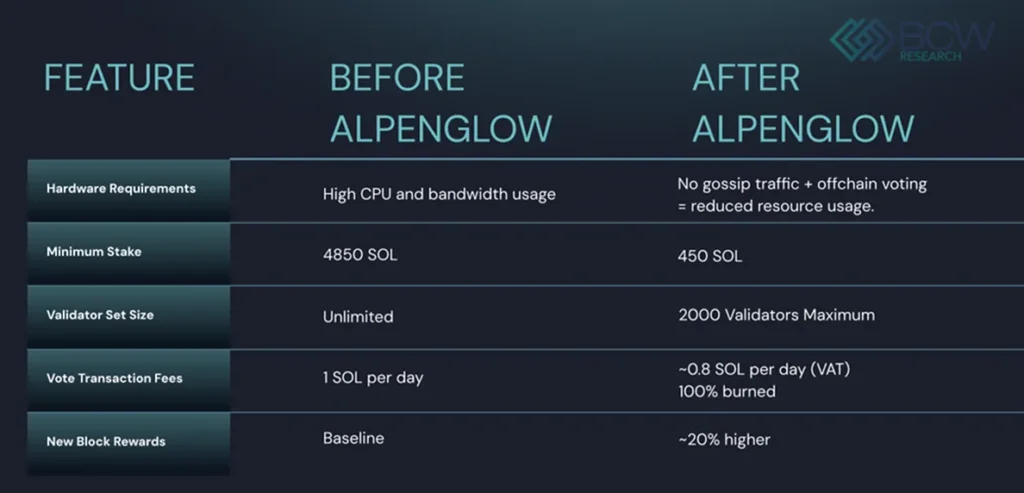
Bandwidth and compute requirements will see significant optimisations. Costly gossip traffic will be eliminated, and onchain signature verification will be replaced by local signature aggregation.
Voting Mechanism and Finality
Additionally, votes will now be sent directly between validators rather than being processed as onchain transactions via the Votor mechanism. Only the outcome of the voting process gets posted onchain rather than all the votes individually. Such a mechanism frees network bandwidth and consolidates the governance process.
Because Alpenglow is partially-synchronous, the network will be much more resilient to timing errors, DOS attacks, and adversarial network conditions.
Alpenglow achieves faster finality by allowing blocks to be confirmed in a single round of voting if 80% of the network’s stake participates. If participation is lower, it can still finalize blocks in two rounds with just 60% of the stake.
Economic Shifts
Beyond technical performance, Alpenglow introduces critical economic changes that will lower the barrier to entry for securing the network.
Most prominently, the minimum stake required to launch a new validator will drop from 4,850 SOL to just 450 SOL. The lower minimum threshold is balanced by a validator set cap of 2,000.
Higher Net Rewards
Hardware requirements and infrastructure costs for validators will decrease as overall CPU usage drops. Simultaneously, vote transaction fees, which function via Validator Admission Tickets (VAT) that are 100% burned, are expected to decrease from roughly 1 SOL per day to 0.8 SOL, boosting net block rewards by about 20%.
Finally, the upgrade eliminates harmful incentives, such as validators waiting to cast more profitable votes. Alpenglow does not include any mention of slashing to disincentivize bad actors, but community discussion hints at such a proposal coming in 2027.
Conclusion
Together, these technical and economic improvements promise to make Solana faster, more secure, and more accessible for operators and users across the entire Web3 ecosystem.
For validator operators, such as stakeFi, the primary benefits are a lower break-even point and reduced hardware requirements.
Meanwhile, the Solana network as a whole benefits from faster finality and more meaningful traffic.
Discover stakeFi’s institutional digital asset yield platform at stakefi.network.