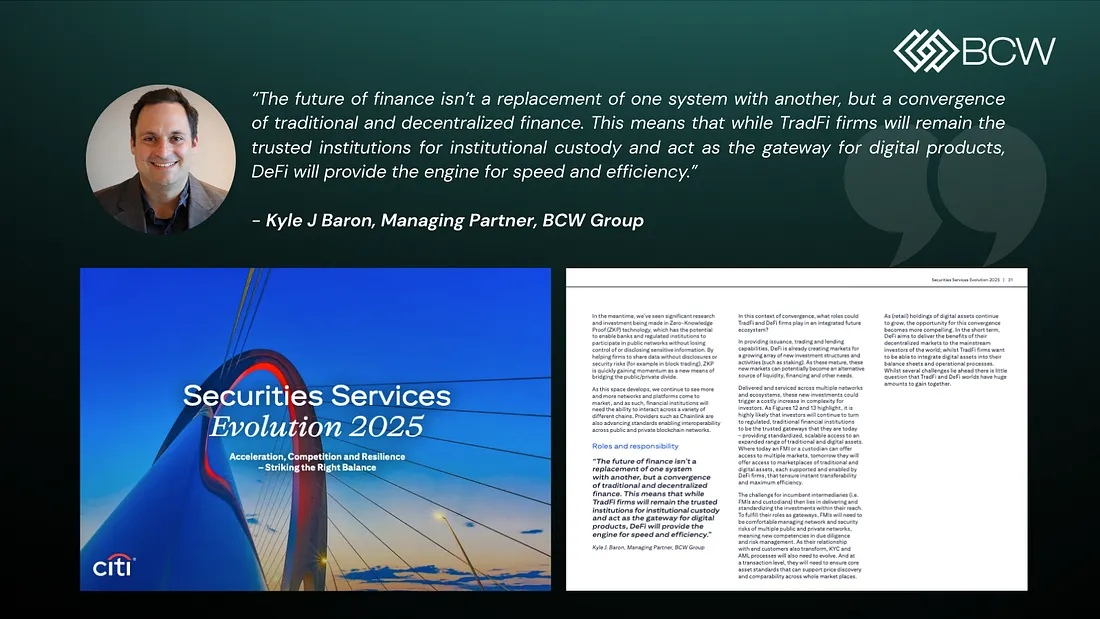

Our Institutional Asset Staking Report highlights the presence of significant capital from major institutions that are helping to maintain blockchain network security with digital asset staking.
Download the full report at https://www.bcw.group/2025-institutional-digital-asset-staking/
The report by BCW Research illustrates how institutions are pouring capital into digital asset staking.
This is evidenced by Q2 reporting of $91B USD in Bitcoin held by 13F filing institutions (60.9% QoQ growth), Real World Assets (RWAs), like BlackRock’s BUIDL tokenized fund token, valued at $24B USD (24% QoQ growth), and the stablecoin market valued at $240B USD in total value (5% QoQ growth).
Regulatory tides have changed for the positive in key jurisdictions such as Hong Kong, the United Arab Emirates (UAE), and the United States. Examples include the SEC stating most staking activities are not securities in the USA, the CBUAE publishing payment token services regulation in the UAE, and Hong Kong approving Spot In-Kind Crypto ETFs with staking approved.
How Institutions Onboard to Crypto
A generalized pathway for institutions into crypto suggests a progression that begins with buying BTC or ETH ETF shares, followed by engaging with onchain proofs-of-concept and functional products. It generally ends by becoming fully engaged onchain with tokens and yield farming.
Most institutions are currently in the early stages (Steps 1–3), but early movers are pushing into Steps 4–6. As they become comfortable in the middle stages, the next logical step is to figure out how to generate additional yield, and BCW Research believes that staking is that next step.
Read our blogs explaining restaking and liquid staking to gain a deeper understanding of those blockchain primitives.
Requirements for Further Onboarding
Longer term, institutional capital is expected to flow into other yield-generating activities, specifically DeFi primitives like lending and vaults, although this requires further regulatory clarity.
For institutions to onboard further into crypto, whether through staking or DeFi, they will require enterprise-grade applications and infrastructure. Solution providers like BCW, Fireblocks, and Google Cloud help power this institutional transformation by providing necessary components and infrastructure.
Potential implications of this trend include:
- Regulatory clarity in early-moving jurisdictions prompting slower ones to also allow staking, increasing institutional demand.
- Increased token demand reducing available circulating supply, which may impact token price.
- Institutional capital increasing staking ratios for protocols, which could lead to yield compression on reward rates.
- Increased demand and Total Value Locked (TVL) growth for restaking and liquid staking protocols.
- Accelerated inflows into DeFi via institutionally-owned liquid staking tokens, potentially creating a DeFi resurgence.
About BCW Group
BCW Group is an enterprise solutions firm & venture studio dedicated to building cloud, Web3 & AI infrastructure that connects and interacts with the on-demand digital universe.
With over half a decade of experience, BCW is a SOC 2 Type II certified organization adhering to the highest standards of security and operational excellence across our business lines, which include enterprise infrastructure technologies, cloud solutions, products, and ventures.
We have launched innovative products in areas such as DLT interoperability (hashport & BCW DVN on LayerZero), API’s and infrastructure tools (Arkhia), DLT naming service (HNS), onchain data analytics (OpenBlocks.ai — acquired, formerly Blockpour), Institutional-grade Staking platform (stakeFi) & onchain Proof attestation (witnessd.ai)
Learn more about BCW Group at bcw.group or follow us on Twitter and LinkedIn.